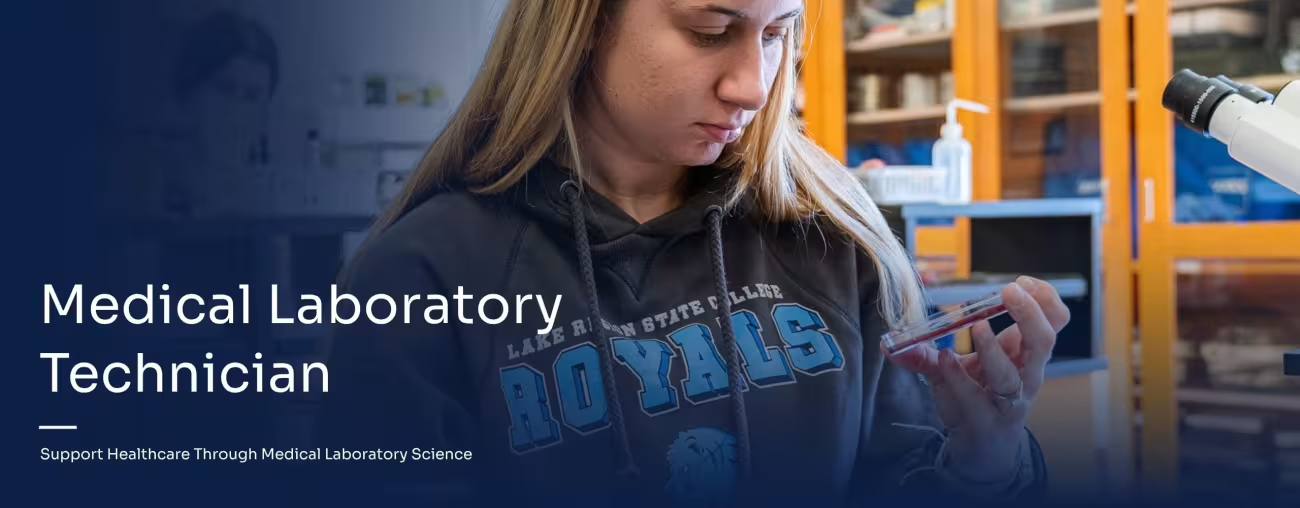
Medical Laboratory Technician
Medical laboratory technicians work behind the scenes performing testing that guides medical decisions. Lake Region State College prepares students through applied lab training and classroom learning focused on real clinical procedures used in healthcare settings. View the Medical Laboratory Technician Advising Sheet.
Medical Laboratory Technician State Licensure Information
PROGRAM OVERVIEW
PROGRAM OVERVIEW
The Medical Laboratory Technician (MLT) program at Lake Region State College (LRSC) is a college-based program started in 2026. The program features a dedicated, non-biohazard teaching laboratory where students learn foundational laboratory skills, including microscopy, pipetting, and essential laboratory operations. For biohazardous and clinical-specific learning, students gain hands-on experience in laboratory spaces at clinical affiliate sites. Additionally, simulation-based learning is used to introduce clinical procedures in a safe, controlled environment before students practice in real-world settings.
The MLT program is located at the LRSC Grand Forks Education Building, 1300 S. Columbia Rd, Grand Forks, ND 58201-4012.
Mission
The mission of the Medical Laboratory Technician program is to provide high-quality education that prepares students to enter the workforce as skilled professionals, positively impacting healthcare and community health through accurate laboratory practice in the state and surrounding regions.
Program Goals
- Deliver a high-quality, current curriculum that reflects best practices, promotes critical thinking, and aligns with Lake Region State College and National Accrediting Agency for Clinical Laboratory Science standards.
- Provide a student-centered learning environment that supports success through individualized advising, mentorship, accessible instruction, and engagement with faculty and staff.
- Prepare competent, career-ready graduates who meet entry-level standards, are employable across diverse laboratory settings, and are positioned for career and professional advancement in medical laboratory practice.
- Promote and advocate for medical laboratory professions.
Student Learning Outcomes
Upon completion of the Medical Laboratory Technician (MLT) program:
- The student will develop the technical skills required for practice as an entry-level Medical Laboratory Technician.
- The student will apply troubleshooting techniques and problem-solving strategies relevant to entry-level medical laboratory practice.
- The student will integrate theoretical knowledge with laboratory procedures to support accurate testing and patient care.
- The student will recognize and demonstrate professional behaviors essential to entry-level practice in the medical laboratory profession.
- The student will incorporate principles related to LRSC student learning goals, including communication, critical thinking, and professional readiness.
Accreditation
The LRSC MLT Program has applied to the National Accrediting Agency for Clinical Laboratory Sciences (NAACLS) which is located at 5600 N. River Rd, Suite 720, Rosemont, IL 60018-5119.
The LRSC MLT Program is accredited by the Higher Learning Commission. Please see the following website for verification and dates for each college. https://hlcommission.org/
HOW TO APPLY
HOW TO APPLY
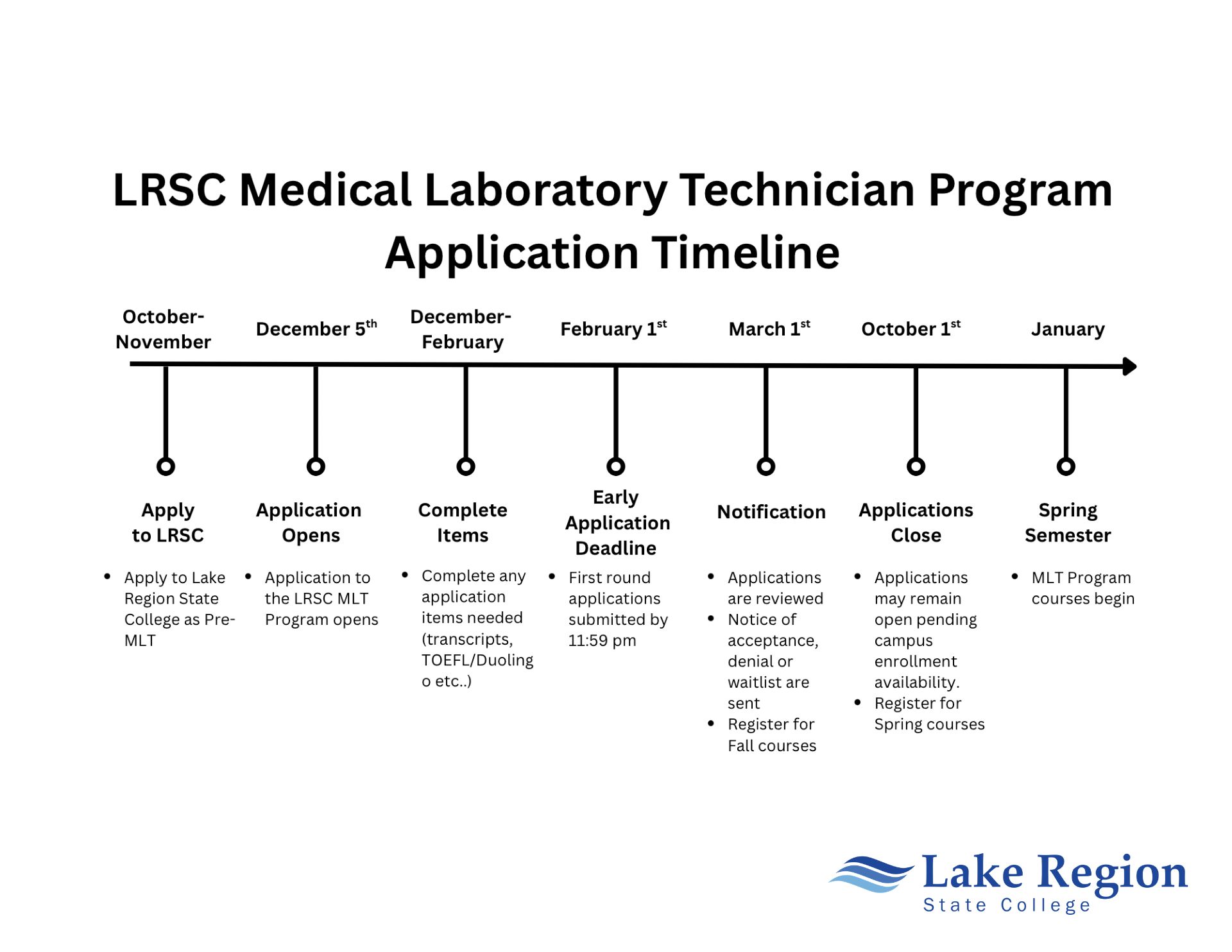
Students interested in the Medical Laboratory Technician program should refer to the application timeline and review admission requirements. Application questions may be directed to Heather Mayers, Instructor & Program Director.
PROGRAM OUTCOMES
PROGRAM OUTCOMES
The following outcome statistics are tracked and monitored as part of continuous program assessment and accreditation for the LRSC MLT program.
Graduation Rate
- The percentage of students beginning the second half of the program that go on to successfully graduate will be at least 70% each year*.
Certification Exam Pass Rate
The percentage of graduates passing ASCP or AMT Certification exam will be at least 75% each year*.
This excludes graduates with first attempts greater than one year after graduation.
Employment/Placement Rate
The percentage of graduates that find employment (for those seeking it) or continue their education within one year of graduation will be greater than 70%* each year.
*Rate established by the NAACLS as a quality measure of its accredited programs
CURRICULUM
CURRICULUM
Courses | ||
| UNIV 101 | Introduction to College Life | 1 |
| ENGL 110 | College Composition I | 3 |
| CHEM 115 | Introduction Chemistry* *CHEM 121: General Chemistry I can also be substituted for CHEM 115 | 4 |
| BIOL 220 | Anatomy & Physiology I | 4 |
| MLS 101 | Introduction to Medical Laboratory Science | 1 |
| MATH 103 | College Algebra** **Other qualifying general education MATH courses can be substituted (MATH 105, 107, 210) | 3 |
| MLS 226 | Clinical Immunology | 2 |
| COMM 110 | Introduction to Public Speaking | 3 |
| BIOL 221 | Anatomy & Physiology II | 4 |
| MLS 220 | Clinical Laboratory Operations | 3 |
| MLS 222 | Clinical Hematology & Hemostasis I | 4 |
| MLS 112 | Introduction to Molecular Diagnostics | 2 |
| MLS 250 | Clinical Microbiology I | 4 |
| MLS 230 | Clinical Chemistry I | 4 |
| MLS 114 | Clinical Urinalysis & Body Fluids I | 3 |
| Humanities or Social Science: Any qualifying general education courses Recommended: PSYC 111, SOC 110 | 6 | |
| MLS 234 | Clinical Chemistry & Urinalysis II | 3 |
| MLS 224 | Clinical Hematology & Hemostasis II | 2 |
| MLS 244 | Clinical Immunohematology II | 2 |
| MLS 254 | Clinical Microbiology II | 2 |
| MLS 260 | Professional Issues in Medical Laboratory Sciences | 3 |
PROGRAM TEXTBOOKS
PROGRAM TEXTBOOKS
Clinical Immunology (MLS 226)
Miller, L. E. (2026). Stevens’s clinical immunology: A laboratory perspective (Sixth edition). F.A. Davis.
ISBN: 978-1-7196-5071-7
Clinical Laboratory Operations (MLS 220)
Turgeon, M. L. (Ed.). (2023). Clinical laboratory science: Concepts, procedures, and clinical applications (9th edition). Elsevier.
ISBN: 978-0-323-82934-2
Molecular Diagnostics (MLS 112)
Buckingham, L. (2026). Molecular diagnostics: Fundamentals, methods, and clinical applications (4th edition). F.A. Davis.
ISBN: 978-1-7196-5113-4
Clinical Hematology & Hemostasis (MLS 222 & MLS 224)
Rodak, B. F., Keohane, E. M., Butina, M. M., Mirza, K. M., & Walenga, J. M. (2025). Rodak’s hematology: Clinical principles and applications (Seventh). Elsevier.
ISBN: 978-0-3239-3768-9
Clinical Immunohematology (MLS 242 & MLS 244)
Harmening, D. (Ed.). (2019). Modern blood banking & transfusion practices (Seventh edition). F.A. Davis.
ISBN: 978-0-8036-6888-1
Clinical Urinalysis and Body Fluids (MLS 114 & MLS 234)
Brunzel, N. A. (2023). Fundamentals of urine & body fluid analysis (Fifth edition). Elsevier.
ISBN: 978-0-323-71197-5
Clinical Chemistry (MLS 230 & MLS 234)
Bishop, M. L., Fody, E. P., Siclen, C. V., Mistler, J. M., & Moy, M. (Eds.). (2023). Clinical chemistry: Principles, techniques, and correlations (Ninth edition). Jones & Bartlett Learning.
ISBN: 978-1-284-23886-0
Clinical Microbiology (MLS 250 & MLS 254)
Mahon, C. R., & Lehman, D. C. (2023). Textbook of diagnostic microbiology (Seventh edition). Elsevier.
ISBN: 978-0-3238-3272-4
Recommend Parasitology: Leventhal R. Medical Parasitology a Self-Instructional Text. 7th Edition. Philadelphia: F.A.Davis, 2020.
ISBN: 978-0-8036-7579-7
What is a Medical Laboratory Technician?
Medical laboratory technicians, sometimes referred to as clinical laboratory technicians or medical technicians, are key members of the health care team. They are concerned with the study and practice of diagnostic medicine by generating accurate and reliable test results in chemistry, hematology, immunology, immunohematology, and microbiology. The results provide valuable information that is used to diagnose and treat disease.
What Can You Do With a Medical Laboratory Technician Degree?
Employment opportunities exist not only in hospitals and clinics, but also in physician offices, government agencies, industry, research, the armed forces, and health-related facilities. A workforce shortage of medical laboratory technicians has generated strong demand for new graduates. In addition to immediate employment opportunities, many graduates continue their education through bachelor's degrees in medical laboratory science, medical school, or graduate programs in science, management, or education.
The Role of a Medical Laboratory Technician
The medical laboratory technician is qualified through academic and applied science education to provide services in medical laboratory science and related areas within rapidly changing healthcare delivery systems.
- Perform, develop, evaluate, correlate, and assure accuracy and validity of laboratory information
- Collaborate in the diagnosis and treatment of patients
The medical laboratory technician has diverse and multi-level functions in:
- Collecting, processing, and analyzing biological specimens
- Applying principles, methodologies, and performance of assays
- Problem-solving
- Troubleshooting techniques
- Understanding the significance of clinical procedures and results
- Interpreting and evaluating clinical procedures and results
- Applying principles and practices of quality assessment across major areas of the contemporary clinical laboratory
Medical laboratory technicians practice independently and collaboratively while being responsible for their own actions, as defined by the profession. They have the knowledge and skills to educate laboratory professionals, other healthcare professionals, and the public about laboratory practices.
The ability to relate to people, demonstrate calm and reasoned judgment, and show commitment to patients and healthcare teams are essential qualities. Communication skills support collaboration with healthcare professionals, external relations, customer service, and patient education. Laboratory professionals demonstrate ethical and moral principles necessary for maintaining the confidence of patients, professional associates, and the community.
Source: NAACLS MLT Unique Standards, 2024
Questions About Medical Laboratory Technician?
Connect with a faculty member to learn more about admissions, requirements, and the Medical Laboratory Technician program.
Heather Mayers, Instructor & Program Director
701-662-1483 | Heather.k.Mayers@lrsc.edu